
We Are Not Alone
UFOs, Parents and Other Mysteries

We Are Not Alone: UFOs, Parents and Other Mysteries
It took a while for me to realise that every film my father took my brother and I to see in the 1970s was something he also wanted to see himself. No Herbie Goes to Monte Carlo or The Muppet Movie for him. The big blockbuster of 1978 was Spielberg’s spectacular Close Encounters of the Third Kind, and so, one evening during our third and final visit to Paris, we made the car journey from his flat in Sceaux to a Right Bank cinema where we sat spellbound for two extraordinary hours watching it. We really had no idea what to expect. Luckily, Close Encounters was in the VO, which our trusty Pariscope guide told us meant the version originale, so we wouldn’t have to endure it dubbed into French.
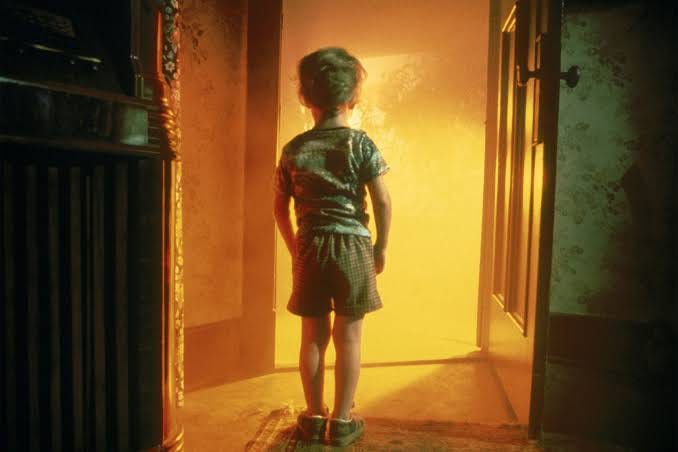
The film opens like a horror movie, with one unexplained incident following another. We start off in a desert sandstorm, coming across the ghostly planes from Flight 19, intact since their disappearance in the Bermuda Triangle in 1945. A benign Frenchman (who our father later told us was the great French director François Truffaut) talks to a toothless old man who tells him the previous night the sun came out and sang to him. Then we’re in a big house on the Plains, its windows open to the summer night, with a young boy watching his toys leap into frenzied life while the contents of a big American refrigerator spills onto the floor. Soon he’s running outside under a huge starscape pursued by his frantic single-mother in denim shorts. Then we’re in a more familiar domestic kitchen with a family man on the verge of breakdown as his kids run riot at bedtime. A powercut outs the whole neighbourhood so he sets off in his pick-up truck to assist. But when he’s held at a level crossing, intense lights from the sky pin his truck to the road. Everything in his driver’s cab goes berserk. The CB radio. The dashboard gauges. The road maps and junk-food cartons. The lights are so bright half his face is sunburnt. Soon he’s tearing round a bend on a mountain road, where he almost runs over the little boy from earlier. There he joins a group of expectant ordinary folk, including the boy’s mother, to witness their first beguiling UFOs under a vast indigo sky.
It was an incredible opening twenty minutes, and we watched open-mouthed as the film unspooled. We were gripped by the spectacle of the family man – Roy Neary, played by Richard Dreyfus, who we recognised from Jaws – slowly becoming a child himself, obsessively making models of a mysterious tower, first out of shaving foam, then out of anything his can find; creating a fat mountain of junk and clay in his living room. In the process, Neary destroys his marriage. But as with Jaws, his real battle is with the authorities, who desperately want to cover up the existence of UFOs. Soon he finds the mountain he’s been seeking – Devil’s Tower in Idaho – along with Jillian, the single mother of the little boy who’s been abducted by an alien lifeforce in a terrifying scene earlier on. They both want the answers that everyone is withholding. The two join forces before the astonishing Mothership descends…
On the journey back from the cinema in the car, we couldn’t stop talking about the film. I remember the empty streets of Paris flying past, my head full of UFOs and the possibility that we are not alone. Close Encounters of the Third Kind had a dramatic effect on us both. But, as with The Spy Who Loved Me, I can see now that something deeper was going on. In Hanif Kureishi’s memoir of his father, My Ear at His Heart, he observes: ‘Whether they like it or not, children are always doing research into one marriage and discovering a great deal about disagreement, pleasure and the fate of love’. That ‘one marriage’ is, of course, your parents’ marriage, and we were no different in this regard. For the past two years, since our mother told us she didn’t love our father and was going to get a divorce, and the intrusion of our future stepfather, Keith, we had been trying to put the pieces together. And with very little help from outside. We knew no other families who had disintegrated like ours. At school, we were the only kids from a ‘broken home’ in our class. We were occasionally taunted for this and made to feel like damaged goods. James and I had spent a great deal of time observing our mother and father together in an attempt to make sense of their forced neutrality, their unconvincing lip-service to the notion of family, when, in all reality, we weren’t part of one any longer. Furthermore, the divorce hadn’t happened yet and we were still in limbo, living in the family home. For two years, apart from some weekends and the solo-parent trips to Paris and Norfolk, we’d barely seen our father. What had replaced him was Keith, and the spectacle of our mother’s all-consuming passion for him. That this had recently turned sour, with their house-shaking arguments, was even more perplexing. We were, as Kureishi writes, discovering much about disagreement and pleasure as we watched our mother and Keith prance around the living room to the disco hits of the day. Also as we cowered, in time-honoured fashion, behind the banisters, listening to them rowing after we’d been put to bed. Was this normal, we asked? Was this just what happened next? Did families always implode? Did love always give way to violence, recrimination, chaos?
Spielberg’s ‘Everyman trilogy’ of films, Jaws, Close Encounters, and later E.T., are, apart from superb entertainments, intense meditations on notions of family. Mark O’ Connell describes this aesthetic of ‘domestic disillusion’ well in Watching Skies, his book about Star Wars, Close Encounters and late-70s American Movies. Spielberg was himself the product of a broken home, and many of his films obsessively probe what that might mean for children caught up in their parents’ divorce; what it might mean for conceptions of family, of home, of innocence versus experience. We had already seen the Brody family in Jaws as a paragon of domestic stability; the unit that sticks together. In Close Encounters, we see the Nearys’ marriage disintegrate before our eyes. This held a potent charge for two nine-year-old twins sitting in a Right Bank cinema. We were witnessing something similar happen at home. The character of Jillian was affecting too. She was a single mother struggling on her own. For most of the time, when our father and stepfather were absent, our own mother was in this role. She was doing it all solo, while heroically trying to hold down a demanding NHS job. Later, it would feel even more like we were, to use the oxymoron, growing up in a ‘single-parent’ family. But all that was to come. At the time, we were just kids from a broken home, trying to make sense of it all. To make sense of absent fathers and violent stepfathers. Of parents in love with adults who you weren’t related to. Of emotional and physical violence, and its tainting intrusion into our young lives.
The sadness of this.it’s easy not to remember that your parents were just as confused and desperate, wounded and muddled, as a y other human being.