
Passing Home
The Less Deceived

Passing Home: The Less Deceived
In the early 90s, living in a north London bedsit while trying to launch a band with my twin brother, I discovered the work of Philip Larkin. Or rather, I began seriously to read – and identify with – his verse. Before the publication of his letters which revealed repugnant racist views, Larkin had been a familiar, grumpy, avuncular figure in the 70s and early 80s, perhaps the most famous poet in the country bar John Betjeman. His much-parodied lines about your parents fucking you up were hard to avoid. By that point in my life, I was beginning to believe there was some truth in them.
Broke and alone – and attempting to write verse of my own when I wasn’t penning songs – I would read a Larkin poem on waking every morning. Lying there in my mould-mottled duvet, his lines about home (the sadness of it), family (or the lack of it), and love (ditto) were revelatory. Like old Mr Bleaney, I’d somehow managed to wash up in a ‘hired box’, living alone with the handful of possessions I’d rescued from my Hertfordshire hometown of Hitchin when my brother and I left at nineteen to seek our fame and fortune in the big city. But fame and fortune, or even a foot in the door of the music business, were proving elusive. Daily, I was beginning to feel the full intensity of Larkin’s notion that ‘how we live measures our nature’. I was twenty-three, yet I was living like one of the sad old men that haunt his poetry. The particular volume I read from every morning was Faber’s Collected Poems, which contained previously uncollected verse, such as the striking (and vaguely terrifying) ‘Love Again’, with its protagonist who finds himself wanking at ten past three. Its last stanza resonated with chilling efficiency. When the speaker asks himself how he got into such a sad and sorry mess, the answer returns as ‘something to do with violence a long way back/ And wrong rewards/ And arrogant eternity’.
Violence a long way back.
It was only in my early twenties when I really took stock of my parents’ divorce and what my brother and I had endured at the hands of our stepfather in the 1970s and on into the early 80s. It seemed as if violence – and the ever-present threat of it – was the sea we swam in back then. While Larkin didn’t address violence that frequently, it was there, as a subtext all the way through his four slim volumes of verse. Emotional violence, too. The type meted out by parents. Or indifferent lovers. Or society at large, and its endless pressure to conform, to succeed, to keep up with the dance or else you’ll invite failure.
In those bedsit days, there was a strong sense that my childhood had been a web of deception, of gaslighting and deliberate subterfuge. I felt violated, but guilty if I apportioned blame. Children, of course, always blame themselves for their parents’ disasters, but I was no longer a child. I was just trying to make sense of it all, groping around in the dark, trying to connect memory with meaning. The title of Larkin’s second volume, The Less Deceived, made a strong impression on me, though for a long time I had no idea what it meant. It was only when I discovered that he’d taken the lines from Shakespeare’s Ophelia, who complains of being ‘more deceived’ by Hamlet, that I finally understood it. To be more deceived is disastrous. I wanted to be less deceived by the past.
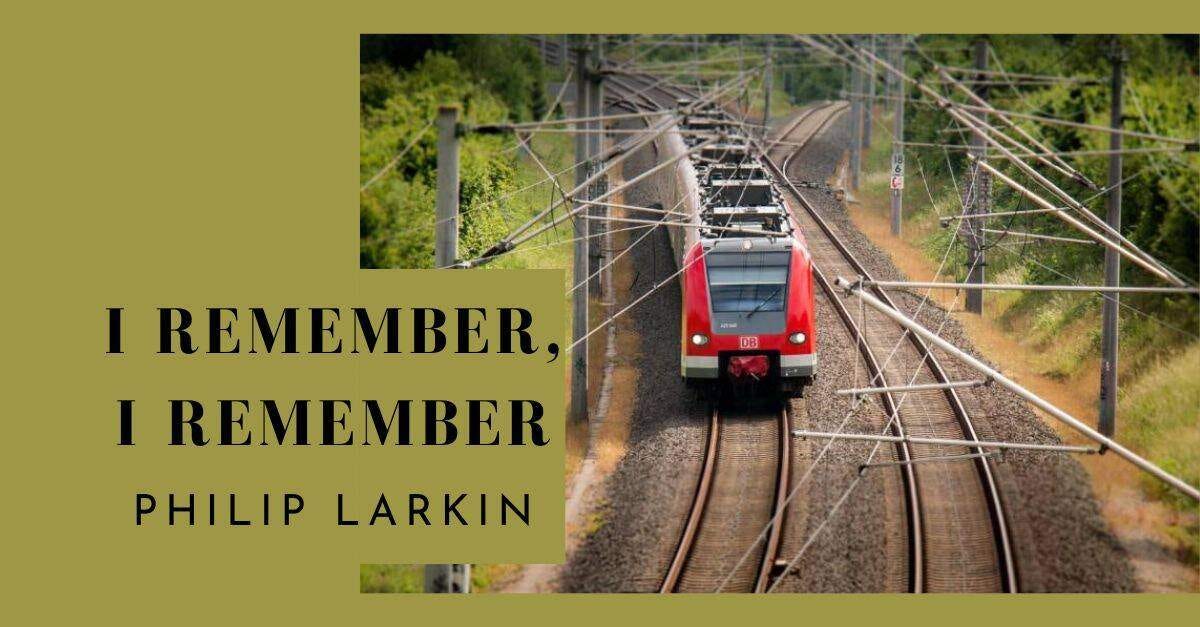
One of the poems from The Less Deceived that I returned to again and again was ‘I Remember, I Remember’. In this, the speaker finds themselves on a train travelling to their hometown of Coventry (which was also Larkin’s). Rather than the experience bringing comfort and a sense of warm nostalgia, of a connection to the speaker’s ‘roots’, they’re surprised to find themselves alienated; shocked at how much the place has changed and how little it means to them now.
The poem resonated so strongly with me because, by then, our mother had moved back to Yorkshire after her brief marriage to our stepfather had predictably failed. There she lived alone in a Dales’ village cottage, still working for the NHS, this time in triage at a local hospital. It was there we would visit her, making the two-hour train journey from Kings Cross to Leeds, which took us, at high speed, past Hitchin and Stevenage. While the train always made a stop at Stevenage, it never stopped at Hitchin. Apt, perhaps, as it seemed to reinforce the sense of the past being ungraspable; of it flying past unstoppably in a few seconds. And fortuitous, for if the train had stopped, I would have been tempted to get out and take a look around. As it turned out, I wouldn’t return to my hometown until I was in my early 30s. As Morrissey sang about his reluctance to go back to the old house, there were too many bad memories there.
It was Larkin’s poem about his childhood home that would travel with me when we made the journey up north. As the train approached Hitchin there would always be a moment of high emotion as its outlying fields flashed by; its spinneys and riverheads where I’d imagined the summer maenads and dryads dancing. And then the outlying dormitory estates and the bleak, blue-panelled footbridge over which we would trudge to school every morning, skimming a finger along its rail. And then the station itself, blurring past before I could take it all in, and finally the tatty sprawl of streets and breakers’ yards that announced Hitchin had come to an end. Of course, Larkin’s speaker has to debunk ‘the town that had once been “mine”’ with high satire; singling out all the places where their childhood epiphanies and fond memories never occurred. The garden where they weren’t spoken to by an old hat. The ‘splendid family’ they never ran to when they got depressed. The farm where they could be really themselves. In a couple of stanzas, a tirade of adult cynicism blasts away all innocence and youthful happiness. The speaker ends by wishing the place in hell.
Did I wish the same for Hitchin as it galloped past every time I took the train to visit my mother? Not quite. I could never so brutally consign the past to the fires of Hades. But the poem made me wonder whether I should. Whether, by holding on to the past, I was merely perpetuating its pain.
Larkin was a great poet but a terrible guide to adult life (“disappointment is to me what daffodils were to Wordsworth” sounds perversely cool but - but really?) Divorce is miserable for so many children, but do all blame themselves? That sounds luke epically bad parenting.