

In Plain Sight: The Dark Side of the 70s
The 1970s is often characterised humorously as the Decade that Taste Forgot, with its kitschy clothes and tacky sitcoms. But there was a darker, nightmarish side to the decade, too; a special atmosphere of dissipation and menace embodied by the Yorkshire Ripper, and two other serial killers whose sprees of depravity only surfaced years later. While my brother and I gambolled in our grandmother’s garden, Fred West, a man described memorably by Martin Amis as ‘troglodytic’, was torturing and murdering eleven young women, aided by his wife Rosemary, in a faceless Gloucester family house. By the time we moved to a Wimpey estate (ironically named The Poets’ Estate) with our newly divorced district-nurse mother in 1978, Scottish civil servant Dennis Nilsen had begun his squalid campaign of killing and dismemberment, murdering at least fifteen young men over the next four years in a quiet corner of Muswell Hill. All three of these monstrous men changed the way the nation viewed the decade in retrospect. They even challenged notions of how society functioned and cohered. Under the surface of so-called normal domestic life, away from the forced jollity of 70s camp comedians such as Larry Grayson, or kids’ shows such as It’s a Knockout!, appalling crimes were being committed behind innocuous net curtains.
And paedophilia seemed to be everywhere, too. And nowhere. If it wasn’t happening in institutions it was perpetrated in secret at home, where statistically most child abuse occurs. The sexually abusive uncle or stepparent is a cliché. Because of the prevailing societal taboo against bringing the subject up, most of these abuses and assaults went undetected for years, until the culture shifted to one of disclosure, punitive measures and therapy. Back then, if you did speak up, you weren’t believed. You were told you had ‘an over-active imagination’. It was almost as if the grown-ups had been awarded a seigneurial right to interfere sexually with their children, or children in their care. The nonce, or the short-eyes, was everywhere if you cared to look hard enough; hanging around the school gates, in parks, or passing as a pillar of the community. It was this social smokescreen that allowed Jimmy Savile to operate with impunity. When the staggering scale of his abuses was revealed, there were ostentatious displays of contrition and much handwringing. It was all so obvious, they wailed. He was hiding in plain sight. But it was clear some people inside the BBC knew what he was up to. Even John Lydon of the Sex Pistols knew Savile was a monster. In a BBC interview that was never aired, he said: ‘I want to kill Jimmy Savile – he’s a hypocrite. I bet he’s into all kinds of seediness that we all know about but aren’t allowed to talk about. I know some rumours…’ And yet hundreds of children were still allowed into Savile’s orbit, invited to realise their dreams on national television. All of this added to a sense of wayward laissez-faire in the late seventies. There were no rules, or if there were, they were there to be broken by depraved chancers like Savile. As 70s kids, we were told to go out and play and not talk to strangers, but our parents and guardians underestimated the danger out there. Or they were the danger themselves.
On a more global scale, it was a decade of Cold War freeze and blood-drunk dictators. In Cambodia, Pol Pot was slaughtering millions of his own people, a grisly legacy memorialised in Bruce Robinson’s great film, The Killing Fields. And the fall-out from the Vietnam war was still intense. In 1978, two of the biggest movies (and ones we were too young to see) were Coming Home and The Deer Hunter. De Niro’s bearded face was never off the cover of our issues of Film Review and Photoplay, with dramatic pictures inside of him in his vigorous prime, aiming a hunting rifle; or Christopher Walken with a pistol to his sweating head surrounded by jeering Vietcong dicers. Why the film was called The Deer Hunter, we were never sure as we doubted there were many deer in Saigon. It was clear these films were necessary for America to salve the collective trauma and guilt of the war. The following year, Coppola’s Apocalypse Now was similarly everywhere. By this time, we were collecting anything connected with movies, knocking on the door of the Stevenage ABC’s box office and begging for posters once a film’s run was over. One of these was Apocalypse Now, and we coveted the haunting image of the choppers on the dawn raid, superimposed over Brando’s Easter Island face, all refracted through a fug of Agent Orange.
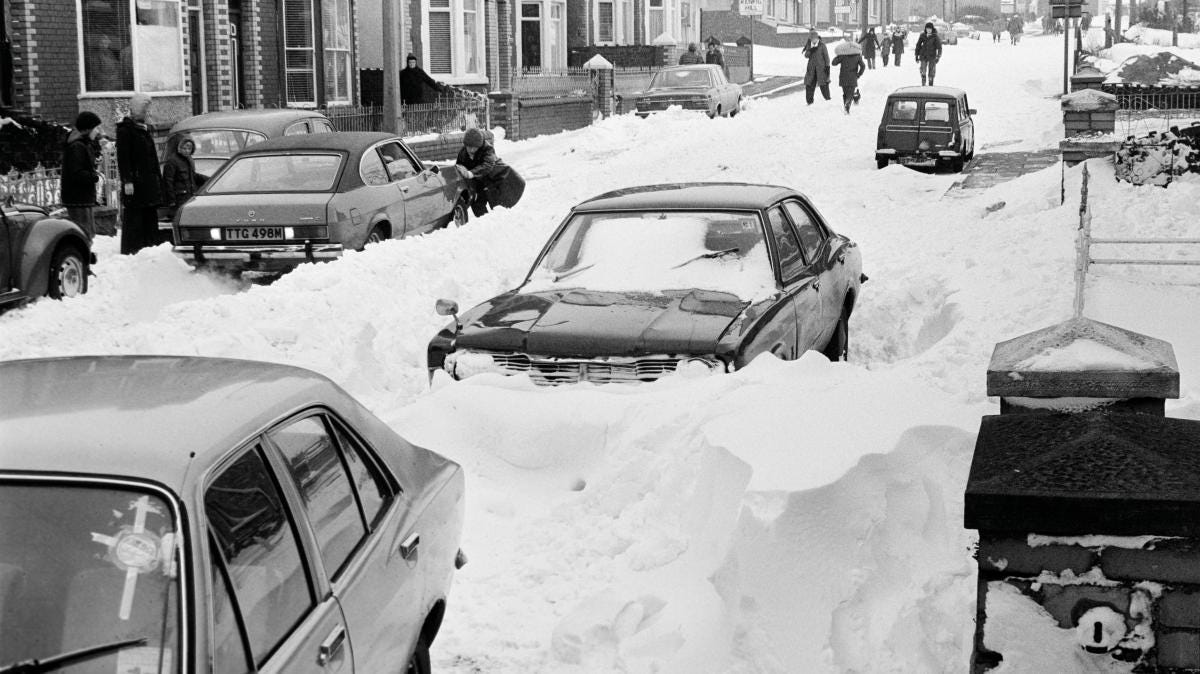
On the domestic front, the snowy winter of 1978 to ‘79 became synonymous with one phrase: The Winter of Discontent. Strikes. Shortages. Picket lines and snow. It was this we lived through during our first months in the new house. In Dominic Sandbrook’s Seasons in the Sun: Britain, 1974-1979, he skilfully evokes the late-70s atmosphere of economic and social decline; of ‘pornography on the newsstands and nudity on the television, a world of splintered communities, atomised families and moral confusion’. While Britain’s loss of status as a world power had been in effect since the end of WWII, the seventies seemed to accelerate a sense of national entropy, with endless trade union disputes, race riots and spiralling crime statistics. Sandbrook dates our ‘national humiliation’ from 1975, when the UK had to beg from the IMF to save its tanking economy. Things swiftly went downhill from there, despite the avuncular Callaghan taking over from the exhausted Wilson as PM.
To two young boys, politics appeared to be an interchangeable parade of ancient men. While our mother took little interest in current affairs, except when it affected the NHS, our father on his weekly return from Paris (where he had moved for work) would listen unstoppably to the worsening news on Radio 4. Or he would sit ignoring us, turning the pages of his Telegraph, which had once been the Guardian at the start of the decade. Despite going on an Aldermaston CND March in the early sixties, the trajectory of his own politics had followed that of Kingsley Amis, shifting from moderate left to immoderate right over ten years. Now he was ranting about Marxists in our universities, football hooligans, the ballooning Welfare State, scroungers, sociologists and feminists.
The financial squeeze of the late seventies resulted in a perfect storm. The Winter of Discontent began quietly enough in a corner of Essex. The down-tools at the Dagenham car plant led to a hauliers’ strike, with the tanker and lorry drivers taking industrial action over pay and conditions. This soon led to petrol shortages and an acute strain on essential goods in shops. I remember there being queues everywhere; interminable waits as our father filled up his blue Citroen, or when our mother dragged us around Safeways. Soon all the low-paid public sector workers were coming out in support of the truckers. Even thousands of BBC staff walked out five days before Christmas, threatening the cosy predictability of the Yuletide Two Ronnies show. For many, this signalled the end of civilisation as they knew it. At the time, I distinctly recall asking my mother why the nurses didn’t strike too: ‘Because people would die,’ she replied, her tone carrying all the thwartedness of committing your life to The Caring Profession.
In the end, the nurses were pretty much the only low-paid workers who didn’t take industrial action, though hospitals were severely disrupted when ancillary staff withdrew their labour. A gravediggers’ strike even meant corpses went unburied for a while. On our trips to London to the Vintage Magazine Shop, we were startled by the mountains of ebony rubbish sacks piled up in Leicester Square, fifteen-feet high, the result of a refuse worker’s strike. The smell of London now wasn’t so much that of intoxicating diesel fumes and enticing chow mein, but the reek of rotting garbage. The whole city stank of terminal financial and moral decay. Strangely enough, it all seemed apt now that our dream of childhood sanctuary had flown, replaced by the freezing, dank, wasteland of The Poets’ Estate. It would take a number of months for the ice to thaw, announcing the false of dawn of the shiny, shameless 1980s.
Grim times, though somehow the present feels even worse. Spot on about the nonces and the adult silence. It was evidently an even bleaker picture for many kids brought up in certain care homes, where paedophilia was rife. I do still remember bread vans being hijacked in London every now and then during the shortages. And then there was the NF…
Thank you for the entertaining take-down of that decade of dreary decline! Yes, it was pretty ghastly, even without the horrors that you rightly foreground. Only to be followed by a different species of ghastliness in the 1980s! I spent time in various towns and cities in the 70s as I started out working in repertory theatres.
Is there any way of declining from imperial grandeur that isn’t going to be a mess, I wonder.