

Between Two Chairs: Writing a Literary Thriller
Literary or Genre. Highbrow or middlebrow. Art or entertainment. Voice or plot. Just some of the binaries the writer of a novel with the slippery definition ‘literary thriller’ must grapple with. Is it, in the end, oxymoronic to describe any work of fiction in such terms? To roll out the cliches (hello, Richard Osman), is attempting to write a literary thriller akin to having your cake and eating it? After the experience of attempting one myself (Time Being, published on 7th September) it certainly feels like being caught between a rock and a hard place. Or, to use the treasurable French expression: avoir le cul entre deux chaises. To have one’s arse between two chairs. The literary thriller is doomed forever to be a hybrid, an outlier; the Frankenstein’s monster of modern fiction.
Or maybe doomed is the wrong word. Perhaps the very slipperiness of the definition allows the writer a happy flexibility. At least that’s what I felt when I finally got going on Time Being in the January of 2023. It was freeing in many ways to attempt this most elusive of literary subgenres. A challenge, too, since I realised very early on that, while I’d seen no end of TV and cinema drama that might be termed thrillers, I hadn’t actually read very many. I immediately reached for the most popular of recent years (Gone Girl by Gillian Flynn) and allowed myself to be seduced by its Swiss watch of a plot and the iron grip its central dramatic situation exerts on the reader. But surely this was purely a ‘psychological thriller’ (or Grip Lit, to use a recent publishing biz handle). Maybe I should be reading works with higher aspirations.
So I turned to the French, to the elegant mysteries of Modiano and Simenon, and to English novelists who’d dabbled in the literary thriller, such as Ian McEwan and Martin Amis, whose novella Night Train might have been the best work of fiction he ever produced. It’s certainly the tightest and most persuasive when it comes to voice. Which is odd, given that it’s narrated by a hard-as-nails female American cop (’A Police’, as the opening tells us) and not his more familiar London yob.
Thus, the book began as a kind of experiment, or a high bar over which to throw oneself. But it developed into something more philosophically searching, with a female protagonist at its centre, grappling with time, mortality, notions of free will and her own past. Time Being follows a London philosophy lecturer, Esther Luck, in the months after her friend and colleague Laura Cameron is murdered on campus. To complicate matters, Esther is fighting cancer and is at a stage in her life where she’s questioning everything. She also knows more than she’s letting on about Laura’s fate, so in that sense she’s an unreliable narrator. I needed to make the book work as an urgent whydunit as well as a philosophical meditation. In a sense it was a challenge that I set myself. Ottessa Moshfegh spoke of doing something similar with her novel Eileen, in that she wanted to use the framework and machinery of a thriller while retaining the register and psychological penetration of a literary novel.
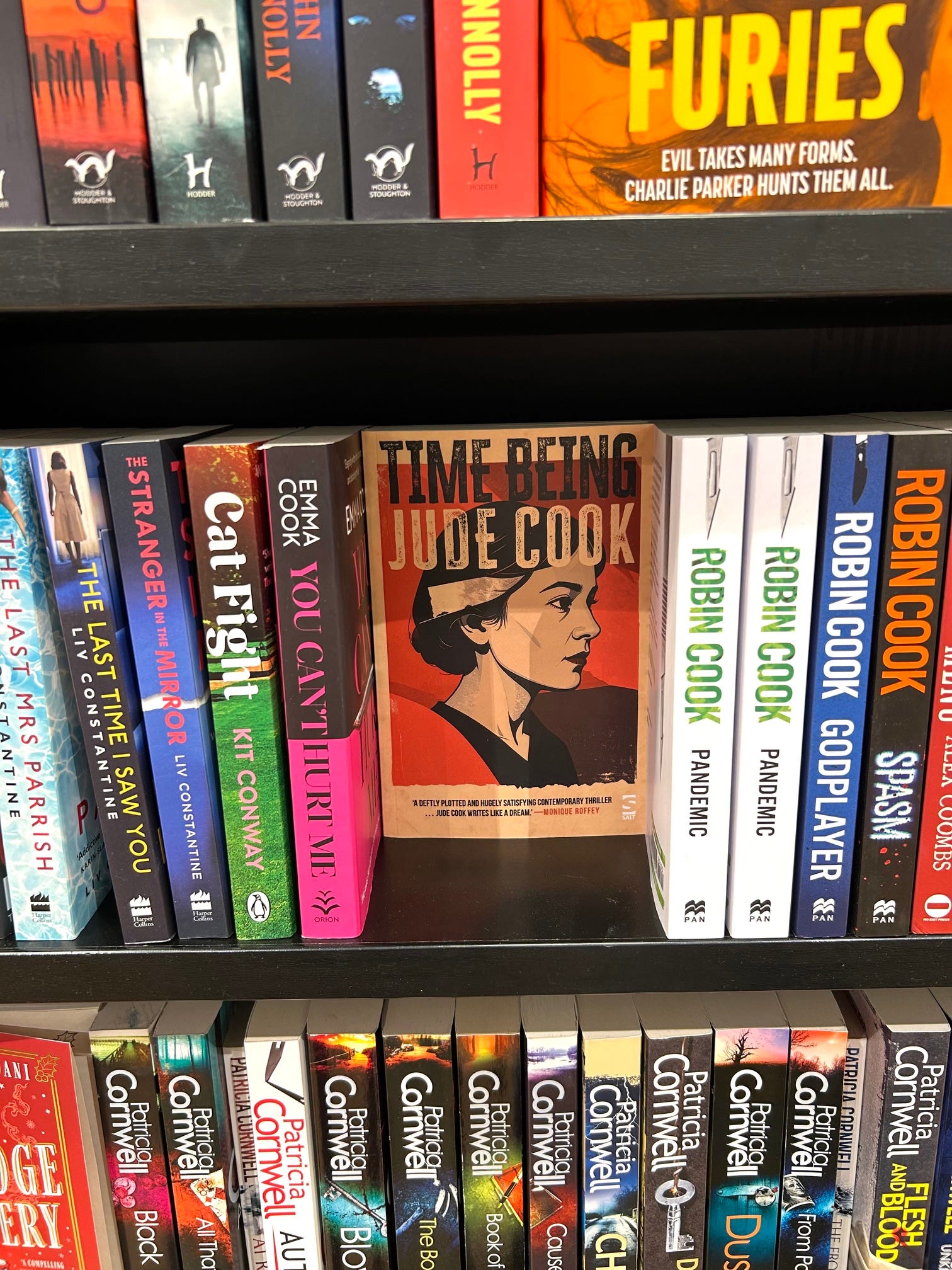
Fast forward three years, however, with the novel happily in the shops, and it became clear that there isn’t much room in bookselling for nuance when it comes to literary sub-genres. The slightest hint of the thriller label will send your literary thriller to the Crime Section of Waterstones. Which is where I found three copies of Time Being in Waterstones Piccadilly, spine-out, nestling next to Patricia Cornwell and the big hitters of the genre. I shouldn’t complain, of course. To have any book by a small independent press (in this case, the venerable Cromer-based Salt Books) in a bricks-and-mortar bookshop is an achievement. But I did wonder briefly, as I stepped out onto Piccadilly Circus, what a reader hungry for cheap thrills and the propulsion of pure plot - for an Airport Novel, in other words - might make of Time Being’s exploration of Kant’s Categorical Imperative or Sartre’s mauvaise foi. It made me smile to think they might find their arse between two chairs, in a rewarding and intellectually stimulating way, of course.
Time Being is out now from Salt Books, priced £10.99
Jude, I just located your book in the US and ordered it. Fascinating--would never have classed Modiano in the mystery / thriller section. Also, I am always bothered by bookstore/publishing categories, so many books to lend themselves that kind of neat labeling. Congratulations about it being happily in the shops!
Great article - reminds me of the Raymond Chandler biog I read, and how he was desperate to be considered literary rather than a pulp writer. And it's not as if thrillers / hardboiled / noir can't examine big themes - loyalty, forgiveness, ethics, secrets etc. As always, the best things fill the gaps.