

August and Everything After: Life’s Rich Pageant and Summer’s End
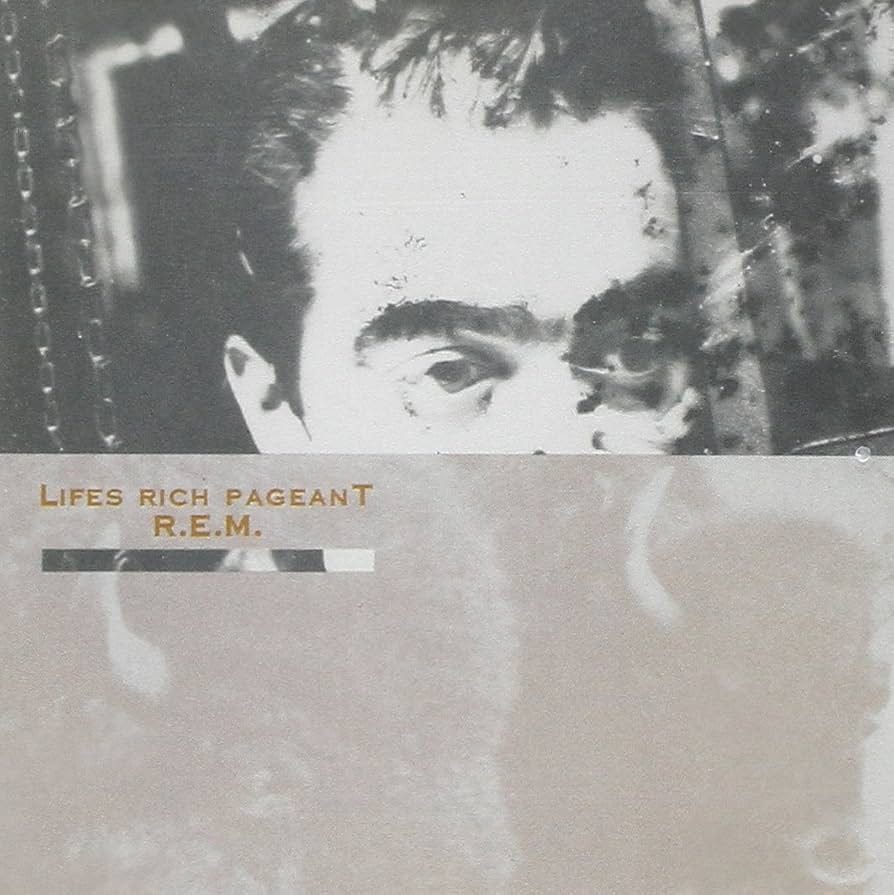
Forty years ago, on July 28th 1986, REM released their fourth album, Life Rich Pageant. I was seventeen, about to turn eighteen and still living between my mother’s house and my father’s house in a Hertfordshire small town. This life-defining album - teeming with angular melodies and startling, half-comprehensible lyrics marinated in the worldly-wise timbre of Michael Stipe’s voice - would infuse all the days of August that would follow, and those of September too, long into the autumn when many things would change.
August really is a strange, unsettling, transitional month, and always the more so for me as my birthday falls on the 25th (as it did for Martin Amis, Sean Connery and still does for Elvis Costello). By the end of every August, I’m always a year older, and the summer is gone. A memory. A done deal. The first of September always feels like the death of promise. In that particular year, I’d perhaps foolishly followed Morrissey’s advice on The Queen Is Dead - another landmark album released a month before REM’s - and spent every dreaded sunny day indoors. There was a strong sense of things being over when that September arrived. Of unfulfilled promise, or frittered time. ‘August, die she must,’ as Paul Simon sang on ‘April, Come She Will’, and it always does, often ignominiously. After eight months, the year starts to sag in the knees, its energy gone; the once lush leaves of the plane trees are coated with dust, and a breath of September enters the air. The autumn winds blow chilly and cold. There are famous songs about September, of course, but August, perhaps, deserves a few more.
For me, the August of 1986 was when adolescence gave way to adulthood, a process which was as much forced as self-imposed. By the end of the month, I’d extricated myself from the bind of moving between the houses of two often-absent parents and found myself a bedsit near the station. Most of my contemporaries had flown their coops for various provincial universities, leaving me alone except for my twin brother, with whom I’d resolved to form a band that would get us out of town. It was an intense time, soundtracked by those strange and beguiling songs on Life’s Rich Pageant, which still sound, to use to the cliché, as fresh as the day they were recorded. It’s a record that’s impossible to ignore, or turn off, from the moment the stylus hits the vinyl. The opening triumvirate of tunes has never been equalled by the band. Starting with ‘Begin the Begin’, with its tortured groans of feedback, followed by the feral, quicksilver ‘These Days’, the final song is the fiercely beautiful ‘Fall on Me’, a song about acid rain, then pressingly relevant following the Chernobyl disaster in April of that year. Always a political band (one thinks of the observation, ‘Jefferson, I think we’re lost’ from Reckoning’s ‘Don’t Go Back to Rockville’) they would become blatantly more so when they arrived at their stadium years. Though their political engagement was never so subtle or as hopeful as on Life’s Rich Pageant. One thinks of the line, ‘Let’s put our heads together/ start a new country up,’ from ‘Cuyahoga’, a song about the Cuyahoga river in Ohio which set alight, so polluted had it become with industrial chemicals. The sentiment is even more relevant today in Trump’s America. Away from the realpolitik, was there a more limpid ballad than ‘The Flowers of Guatemala’? Or a more joyous anthem to life than ‘I Believe’, in which Stipe laments his boyhood years when he was ‘young and full of grace’. Despite this fall from innocence, he still defiantly believes, though not, we imagine, in a religious sense. This faith in life, reaffirmed time and again throughout the album, is what makes it so enduring.
Towards the end of side two, after the abandoned power pop of ‘Just a Touch’, after the gritty sea shanty ‘Swan Swan H,’ (which is possibly ‘about’ heroin, though Stipe’s lyrics were always so associative as to make such literal claims redundant), there’s a final song, a cover of the Clique’s ‘Superman’; a tune my brother and I immediately learnt with its simple, soaring harmonies and earthy pedal between E and A major. We played it at every rehearsal with our nascent band, the Stormboys, who were by then practising three times a week. The venue for this was a blues-party basement rehearsal studio strewn with empty Red Stripe cans, run by the mysterious Mrs Loo, a woman who inhabited the house’s attic. Mrs Loo lurked in this room like a spider, and it was to her web we would venture trepidatiously, up the rickety stairs with a ten-pound note cocked and ready to pay for our session.
Many years before that transitional summer, I’d discovered one of my mother’s Penguin paperbacks by her bed, an Edna O’ Brien novel entitled A Scandalous Woman. The cover was shocking. I was nine years old, and unprepared for a full-bleed photograph of an adult woman standing naked in the window of a cottage, defiantly waiting (we are perhaps meant to believe) for her secret lover. I couldn’t conceive that my mother would want to read such a book, or why she would want to leave it so brazenly on her bedside table. The reason was perhaps to impress our future stepfather, who had once himself been our mother’s secret lover, but who had since installed his size-twelve shoes under the kitchen table and was making our lives hell on a daily basis. The cover spoke of adult intimacies, secrets and betrayals, all the things we heard whispered around the dinner table after we’d been told to get up to bed and clean our teeth or there’d be ‘hell to pay’. There was also another racy-sounding O’ Brien novel beside my mother’s bed: August Is a Wicked Month. The title chosen by O’ Brien wasn’t incidental. August is a time for wantonness, for over-ripe passions, for things gone to seed.
August is also, as far as the gutter press is concerned, ‘silly season’. With parliament in recess, and the carousel of Westminster politics over for a long break, there’s nothing to report on except to magnify absurd, prurient stories. Yet, while growing up, it always struck me that August was the time of significant disasters. Something terrible always happened. The assassination of Mountbatten on his fishing skiff by the IRA in 1979. The invasion of Kuwait by Saddam Hussein in 1990. Then, in the last dusty days of August 1997, the death of Princess Diana after months of hounding by the paparazzi. A cruel and sad, if inevitable, demise. At the time, it wasn’t an REM song that soundtracked this event, but the Manic’s twisted and desperate ‘Die in the Summertime’ from The Holy Bible, released three years before. Most recently, there was the tragic suicide of the Cambridge academic, Jason Arday, after a racist witch hunt in the right-wing press; another needless tragedy, one that can only grow in resonance over the years to come.
For the French, August is sacrosanct. Paris empties every year, and serious business of les vacances begins. No work is to be attempted until la rentrée in September. In Éric Rohmer’s film, Le rayon vert, Delphine, played with understated grace and torment by Marie Rivière, spends the whole month trying and failing to go on holiday with someone after a break-up. It seems everyone has already made plans, and she goes on one abortive solo trip after another. Eventually, she finds redemption in the south of France on meeting a stranger in a railway station after fleeing a disastrous double date. With this promising new man, she witnesses the legendary green ray that can be glimpsed when the sun meets the ocean at dusk. Paul King, the director of the Paddington films, once told me Le rayon vert was the best love story ever filmed. I can’t disagree. It’s also full of the ennui of August, the restless feeling that life is going on elsewhere, or that youth is about to end once and for all unless one grasps the main chance before the window of opportunity closes once and for all.
There are a number weak or terrible albums that happen to have great titles. Knocked out Loaded by Dylan, for instance, or Strangeways Here We Come by the Smiths. One such title is August and Everything After by the Counting Crows, a band I came to despise more than any other in the 90s with perhaps the exception of Right Said Fred. A run-of-the-mill alt-Americana, grunge outfit trading in the wake of Nirvana’s success, Counting Crows nevertheless entranced me with the title of their 1993 breakthrough album. It seemed unfair that they should’ve come up with this poetic title all on their own. I had assumed it was a line from Dylan Thomas, or even Shakespeare, until learning it had originated from the Crows’ August-born songwriter and frontman, Adam Duritz, who had begun and abandoned a song with that title. It was essentially a song about everything that had occurred after the August of his birth - in other words, his whole life. No wonder he threw it away.
Life’s Rich Pageant is an album with a great title that also happens to be genuinely great. Without meaning to, the title encompasses some of the transitional qualities of August. Life - and summer - is passing fast, for better or for worse. There’s nothing one can do but view it stoically, as all part of life’s rich pageant. Indeed, some of the album’s deeper cuts, reveal riches on each new listen. The way Stipe garrulously phrases beautiful young lady on ‘Hyena’ for instance, in a way that’s wholly un-creepy or lascivious. Though Stipe never officially came out as gay, only a gay man could get away with singing such a line. And on side two’s ‘What If We Throw It Away’ there’s a couplet that increases in meaning with every passing year as I get older: ‘Here’s the trailer, Tom/ A year has come and gone’. Yes, it seems to insist, when I listen to the album one final time every October; a ritual before I put it away for another year. Remember the time. It’s later than you think. Begin the begin.
I enjoyed this Jude. Life's Rich Pageant is also an important album for me.